EMV compliance at gas stations is only as strong as its weakest certified link. If a fraudulent transaction hits a non-EMV-compliant pump, the gas station absorbs the chargeback, not the card issuer. That changed in April 2021, when the outdoor fuel-dispensing liability shift took hold across Visa, Mastercard, Discover, and American Express.
TL;DR
- The liability shift moved fraud costs to merchants when the dispenser chain isn’t certified.
- A chip reader alone doesn’t make a gas station compliant. The controller, dispenser brand, and payment processor have to line up.
- EMV compliance and PCI DSS compliance are separate requirements.
- Retrofit kits can run $5,000 to $20,000 per pump, while full dispenser replacement can reach $25,000 to $75,000.
- The forecourt controller is the compliance anchor. If it isn’t certified correctly, the rest of the site can still be exposed.
What Is the EMV Liability Shift and What Does It Mean for Gas Stations?
The EMV liability shift means gas stations, not card issuers, now eat the fraud losses when a chip card runs through a non-certified outdoor dispenser. Visa, Mastercard, Discover, and American Express all moved to this rule on April 16-17, 2021, and it hasn't changed. Every swipe at a non-certified pump is the merchant's problem.
Before the shift, counterfeit-card fraud usually sat with the issuer. After the shift, a single fraudulent fill-up at a non-certified pump can become a chargeback the merchant eats in full. The exposure is operational and immediate.
ACI Worldwide’s survey of 45,000 gas stations, reported by Digital Transactions, found that 48% of fuel and convenience-store sellers had complied as of 2021.
Why Do So Many Gas Stations Still Fall Short of EMV Compliance?
Most fuel dispenser EMV gaps trace back to three problems: aging hardware, an incomplete certification chain, or a controller that hasn’t been certified with the site’s payment processor.
Many stations are still running Gilbarco, Wayne, or Tokheim dispensers that predate EMV. Those sites usually need either retrofits or full replacement. Conexxus has estimated that the average per-location upgrade cost exceeds $200,000.
The certification chain is the bigger problem. A certified card reader on an uncertified controller still leaves the site exposed. The controller has to be certified with the dispenser brand and the payment processor. If one link is missing, the setup is EMV-capable in theory and vulnerable in practice.
Firmware can widen that gap. Some controllers need updates to support EMV at the software level, and older firmware can break certification even when the base hardware is capable. Right hardware, wrong firmware version. The site still fails.
What Is the Difference Between EMV and PCI DSS Compliance?
EMV authenticates chip cards at the terminal. PCI DSS protects cardholder data in transit and storage. A gas station needs both.
EMV handles authentication at the terminal. PCI DSS covers the broader security environment: how card data is protected once it enters the network, where it's stored, and how it moves.
PCI DSS 4.0 became fully effective on March 31, 2025, and it puts more weight on protecting cardholder data in transit. That makes TLS support at card readers and POS systems more important in day-to-day site design.
PA-DSS is different again. It covers payment application security, which means the controller’s software or firmware has to be validated. An operator can buy an EMV-capable controller and still have PA-DSS exposure if the firmware isn’t validated.
| Standard | What It Covers | Who Validates | Gas Station Obligation |
|---|
| EMV | Card authentication at the terminal | Card networks such as Visa, Mastercard, Discover, and American Express | Certified controller, certified reader, certified dispenser brand, and certified processor |
| PCI DSS 4.0 | Cardholder data security in transit and storage | PCI Security Standards Council | Annual self-assessment or QSA audit depending on volume |
| PA-DSS | Payment application security | PCI Security Standards Council | Use validated firmware on the controller |
Operators often close one gap without realizing the other is still open. Buying EMV-certified equipment doesn't touch PCI DSS requirements, and a site can pass EMV certification while still failing a PCI audit.
How Much Does EMV Compliance at the Pump Actually Cost?
EMV upgrade costs range from $5,000 to $20,000 per pump for retrofit kits to $25,000 to $75,000 for full dispenser replacement, with site-level costs exceeding $200,000.
Retrofit kits sit at the lower end because they reuse much of the existing dispenser. Kurv’s 2026 analysis puts the typical retrofit range at $5,000 to $20,000 per pump.
Full replacement is a much bigger lift. A multi-product dispenser can run from $25,000 to $75,000, and a new pump base without accessories may still cost $12,000 to $15,000.
| Upgrade Path | Approximate Cost | What Drives the Price |
|---|
| Retrofit kit | $5,000 to $20,000 per pump | Existing dispenser reuse, reader changes, firmware work |
| Full dispenser replacement | $25,000 to $75,000 per multi-product dispenser | Hardware, labor, software licensing, downtime |
| Site-level full upgrade | More than $200,000 per location | Multiple pumps, network changes, compliance work |
The forecourt controller choice is the single largest variable in EMV upgrade cost. If the controller can be certified with the dispenser brand and processor, a retrofit may be enough.
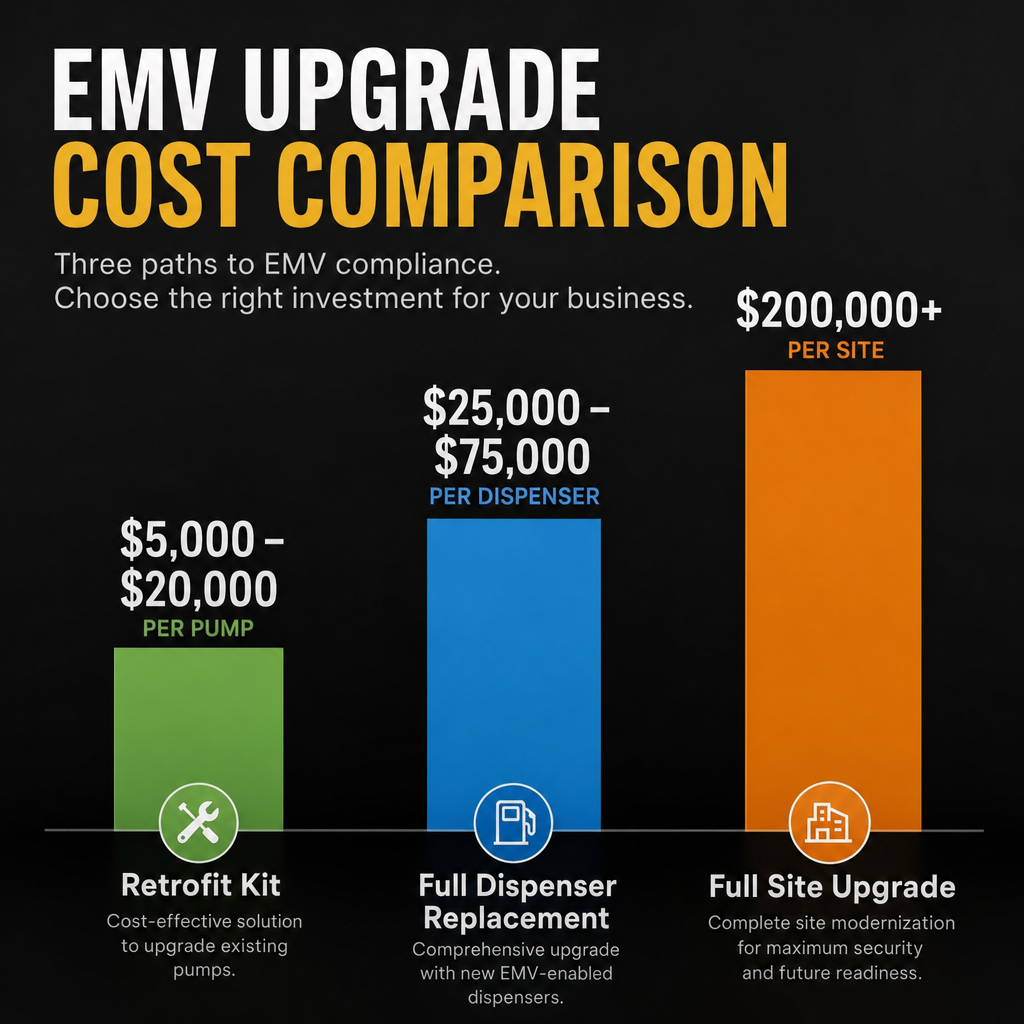 EMV compliance upgrade cost comparison: retrofit kit vs full dispenser replacement vs full site upgrade for gas stations
How Does the Forecourt Controller Fit Into EMV Certification?
The forecourt controller must be certified with both the dispenser brand and the payment processor for EMV compliance to hold. The card reader alone is not enough.
The controller sits in the authorization path, so buying an EMV-certified reader and attaching it to an uncertified controller doesn’t create a compliant system.
In practice, the chain has three links: controller, dispenser brand, and payment processor. All three have to be certified together, and each pairing requires its own certification work. Swap any one element and that piece of the certification restarts.
Among Allied’s controller options, NeXGen PRIME is the controller-level EMV example. It is EMV certified with major dispenser brands and card processors, including Gilbarco, Wayne Fueling Systems, and Tokheim. It is also PA-DSS and PCI compliant, supports TLS at card readers and POS, and integrates with Bluefin Decryptx PCI-validated P2PE. Allied reports that the integration is live at more than 500 petroleum locations and reduces PCI burden by more than 70%, with more than 90% PCI scope reduction at POS.
AEGIS takes a different route. Its Windows-based quad-core platform can host local software and consolidate functions, which can lessen PCI scope.
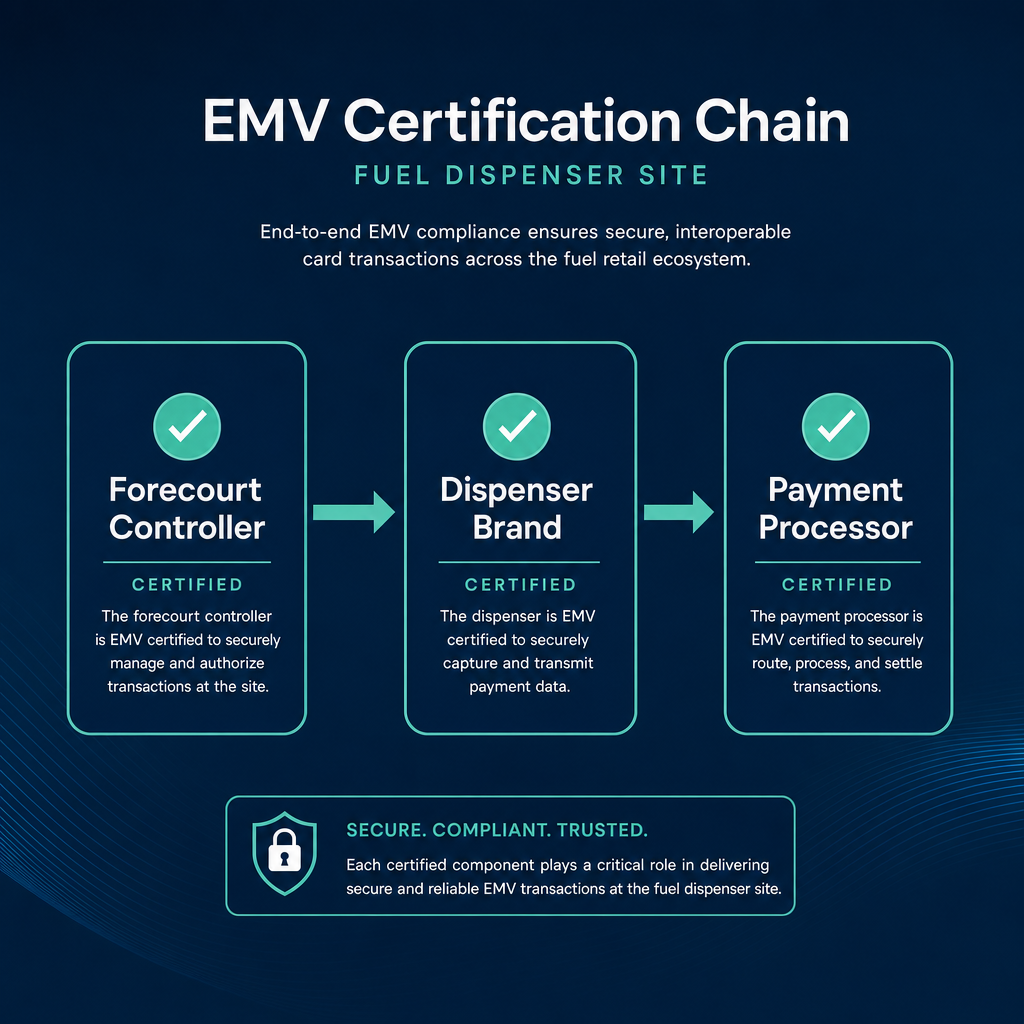 EMV certification chain for fuel dispensers: forecourt controller, dispenser brand, and payment processor all require certification
The right controller doesn’t solve every site problem, but it decides whether the rest of the compliance project can close cleanly.
An 8-Step EMV Compliance Checklist for Petroleum Operators
Petroleum operators can confirm EMV compliance in eight steps, starting with controller certification, dispenser brand pairing, and payment processor certification, which are the most common gap points.
- Confirm controller certification status. Check whether the controller is PA-DSS validated and EMV certified. If this is unclear, the rest of the checklist doesn’t matter yet.
- Verify dispenser brand pairing. Confirm that the controller is certified with each dispenser brand on-site, including Gilbarco, Wayne, and Tokheim. Mixed-brand sites need proof for every pairing.
- Confirm processor certification. Make sure the controller and dispenser combination is certified with the payment processor in use. This is the gap many operators only find after installation.
- Check firmware version. Review whether the controller is running current, validated firmware. Older firmware can break an otherwise capable setup.
- Review PCI DSS 4.0 obligations. Determine whether the site needs a current self-assessment or a QSA audit based on transaction volume and environment.
- Assess P2PE readiness. Confirm whether the controller is integrated with a PCI-validated P2PE solution. If not, document what stands in the way.
- Check TLS compliance. Verify that the controller supports TLS at card readers and POS, which matters more under PCI DSS 4.0.
- Document the certification chain. Keep records for the controller cert, dispenser cert, and processor cert. If a regulator or processor asks, the paper trail should be immediate.
Operators who find gaps in steps 1 through 3, or 5 through 7, should work directly with the forecourt controller vendor. Allied’s technical support team handles compliance assessments for new and existing installations.
Frequently Asked Questions About EMV Compliance at Gas Stations
These questions come up repeatedly when petroleum retailers are working through their compliance status.
What is the penalty for non-EMV-compliant fuel pumps?
There's no fine or government penalty. The cost is the fraud itself. Every counterfeit transaction that goes through a non-certified dispenser lands as a chargeback on the station. At a high-volume site, that adds up fast.
Does EMV compliance at the pump also mean PCI DSS compliance?
No. EMV and PCI DSS cover different requirements. EMV certifies card authentication, while PCI DSS governs cardholder data protection. Both are required.
Which dispenser brands are certified with Allied’s NeXGen PRIME controller?
NeXGen PRIME is EMV certified with major dispenser brands, including Gilbarco, Wayne Fueling Systems, and Tokheim, across a single firmware version.
Is dispenser replacement always required for EMV compliance?
Not necessarily. If the existing controller can be certified with the dispenser brand and payment processor, retrofit kits may achieve compliance without full replacement.
What is P2PE and is it required for EMV compliance?
P2PE (Point-to-Point Encryption) encrypts card data the moment it's read, before it ever touches the network. It's not an EMV requirement, but when the controller runs a PCI-validated P2PE integration, it can take large chunks of the site out of PCI scope entirely.
How can a site confirm whether forecourt-controller firmware is PA-DSS validated?
PA-DSS validated payment applications are listed by the PCI Security Standards Council. The controller vendor should confirm which firmware versions carry current validation.
Conclusion
Since April 2021, the fraud bill at non-certified pumps lands on the operator. Getting compliant isn't just about swapping in a chip reader. The controller, dispenser brand, and payment processor all have to be certified as a unit. EMV and PCI DSS are separate tracks that both need attention. The forecourt controller is the anchor for all of it. P2PE cuts PCI scope meaningfully, but only where the controller is running a validated integration.
The fastest next step is the 8-step checklist above, starting with processor certification.
For operators evaluating NeXGen PRIME or reviewing an existing Allied installation, the technical support team can help assess the certification chain and identify the least disruptive path forward.
Need to assess your site's EMV compliance status?
Allied Electronics has certified NeXGen PRIME with major dispenser brands and card processors at more than 500 petroleum locations. Talk to a specialist about the fastest path to a compliant, certified chain at your site.
Talk to a Specialist →


