


Your Solution for Speed, Security, and Reliability at the Fuel Dispenser
Wireless EMV at the pump does not have to turn into a trenching job. Allied Wireless gives fuel stations a secure, cost-effective way to link the store and each dispenser, installed in just minutes per unit.
Allied Electronics has led forecourt integration since 1978. Its Wireless Forecourt Access Point and In-Dispenser Unit handle the dispenser upgrade without the usual digging, demolition or concrete work.
Go wireless and eliminate permits, downtime, lost revenue, and slow transactions.
Shop Allied WirelessDownload the Product Brief (PDF)
EMV Wireless Solution: This Story Is No Fairytale
You've heard the stories: permits, delays, jackhammers and the cost of running new wires. Allied's cartoon tells a wireless story with a happy ending.
Why Do EMV Upgrades at the Pump Turn Into Construction Projects?
Most forecourts still run on buried 2- or 4-wire lines that can't carry networked EMV data, so the usual fix is new wire: permits, delays, jackhammers and concrete work.
Those aging wire runs carry only current loop or serial data, while networked EMV payment devices need TCP/IP. Digging new runs means downtime, lost revenue and slow transactions, on top of construction and labor costs.
Some big pump companies may say there is no other option. There is: the choice is between aging two-wire technology and wireless fast Ethernet. See the cost of EMV without trenching.
How Does Wireless EMV Work at the Pump?
One Access Point inside the store pairs with an In-Dispenser Unit in each dispenser over a TDMA protocol, creating a private, secure wireless Ethernet connection.
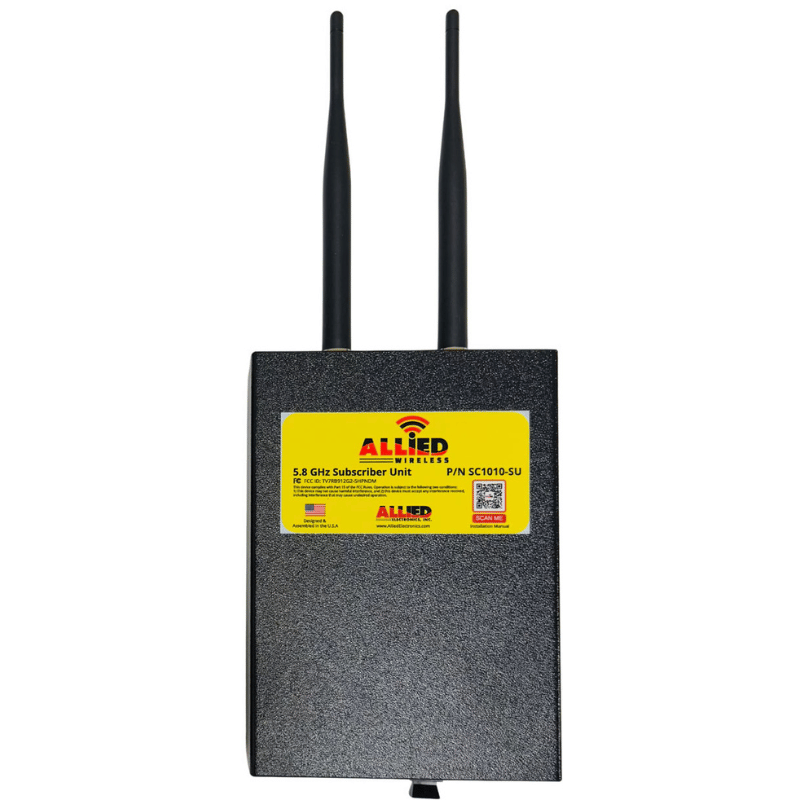
The SC1015-AP Access Point connects to the site's network. Each SC1010-SU In-Dispenser Unit includes a 4-port Ethernet VLAN switch for the card reader, the dispenser and other forecourt devices. The units interface with major fuel dispensers, retail POS systems and forecourt controllers.

- Mount the Access Point. Install it indoors, ideally near a window facing the pumps, never lying on the ground or behind a metal wall.
- Mount an In-Dispenser Unit in each dispenser. Point the antennas up. The unit runs on the dispenser's 24 VDC power through the included adapter cable.
- Pair the units. Use the Allied Wireless Manager Application. Allied Wireless 2.0 units need no USB keys.
- Check the link. The app shows signal strength and up time for each paired unit.
Wireless, but Not Wi-Fi
Allied Wireless uses the 5 GHz band with a TDMA protocol. It is not Wi-Fi. The network name is proprietary and not visible to standard Wi-Fi devices such as laptops, smartphones and tablets.
Bandwidth for Media at the Pump
Ethernet throughput reaches up to 300 Mbps. That is enough for EMV payments plus HD media, video and interactive customer engagement at the dispenser.
Don't Dig: Installed in Minutes per Dispenser
Put down the jackhammer and shovel! Each Allied Wireless unit takes just minutes to install per dispenser, with minimal interruption to the site.
There is no excavating or re-wiring the forecourt, and no digging, demolition or breaking concrete. That cuts construction, labor and shut-down costs.
Watch how fast an Allied Wireless installation goes.
Why Choose Allied Wireless for EMV at the Pump?
Allied Wireless combines IP-speed transactions, encrypted payment traffic and lower installation costs in one wireless Ethernet system built for the forecourt.
Convenient
- Plug-and-play wireless Ethernet
- Transactions at IP speed
- Bandwidth for HD media, up to 300 Mbps
Secure and Reliable
- Proprietary encrypted TDMA protocol
- 256-bit AES encryption
- Payment data on an isolated VLAN channel
Lower Cost
- Reduced construction, labor and shut-down costs
- No digging or downtime
- Installed in minutes per dispenser
Technology
- Maximum-power wireless Ethernet at 5 GHz
- Proprietary RF protocol
- Cloud-managed 4-port VLAN switch in every In-Dispenser Unit
Allied Wireless SC1015-AP and SC1010-SU Technical Specifications
These specifications from the Allied Wireless 2.0 product brief apply to the SC1015-AP Access Point and the SC1010-SU In-Dispenser Unit.

How to Order Allied Wireless
Order one SC1015-AP Access Point ($795) for the store and one SC1010-SU In-Dispenser Unit ($750) for each dispenser, matched to the dispenser brand.
- SC1015-AP Wireless Forecourt Access Point 2.0: $795
- SC1010-SU-G In-Dispenser Unit 2.0 for Gilbarco: $750
- SC1010-SU-W In-Dispenser Unit 2.0 for Wayne: $750
- SC1010-SU-B In-Dispenser Unit 2.0 for Bennett: $750
- SC1008-ANT External Antenna with 8 ft cable, for the Access Point or a pedestal terminal: $145
Other ways to order:
- To purchase Allied Wireless
- Email Allied's Sales Department at [email protected]
- Call 215-785-6200
- Or contact Allied online
Allied Wireless Resources
These documents cover the Allied Wireless 2.0 product, its installation and the earlier first-generation units.
- White Paper: Secure Wireless Ethernet for Fuel Dispenser EMV (PDF)
- Allied Wireless 2.0 Product Brief (PDF)
- Allied Wireless Installation Manual V3 (PDF)
- Allied Wireless Installation Manual V2 (PDF)
- First-generation units (AE58AP and AE584SU): Product Specifications (PDF), Wireless FAQ (PDF) and Installation Manual V1 (PDF)
- Wireless forecourt FAQ: every question operators ask
Frequently Asked Questions About Wireless EMV
Short answers to the questions station operators and service technicians ask most about wireless EMV at the dispenser.
Don't Dig. Go Wireless.
Allied Electronics, Inc. has served the retail petroleum industry from Bristol, PA since 1978. One SC1015-AP Access Point ($795) covers the store, and each dispenser gets an SC1010-SU In-Dispenser Unit ($750).
Shop Allied Wireless